The True Cost of DoorDash, Uber Eats, and Grubhub: What Owners Must Know
The commission rate on your platform contract is not your delivery cost. It is the starting point of a calculation that, for many restaurants, ends near zero — or below it. Understanding the full economics of third-party delivery is not optional. It is the difference between using platforms strategically and subsidizing them unknowingly.
14 min readWritten by: RCS Product Team
What You Will Learn
From Platform Commission to True All-In Delivery Cost
This guide explains what third-party delivery cost actually includes, what each major platform charges, how to calculate your true per-order profitability, and how to use RCS to decide which platforms — if any — make financial sense for your operation.
Third-party delivery cost is the total amount a restaurant pays to fulfill a delivery order through a platform like DoorDash, Uber Eats, or Grubhub — expressed as a percentage of the order revenue. The stated commission rate in your platform contract is one component of this cost, not the whole picture.
The stated commission is what gets negotiated, advertised, and featured in headlines. The true all-in cost includes payment processing fees (typically 2.5–3.5% of order value), visibility and marketing fees for placement and promotions, platform service fees, and in some cases, packaging and tablet subscriptions. When all costs are accounted for, the effective delivery cost routinely exceeds 40% of order revenue — even on contracts with a stated commission of 25–30%.
The market context makes this understanding urgent. DoorDash holds 56% of the U.S. delivery market, Uber Eats 23%, and Grubhub 16%. The U.S. delivery market is valued at $353 billion within a $1.4 trillion global delivery market growing at 9.58% annually through 2034. DoorDash processed $72 billion in customer spending through Q3 2025, a 23% year-over-year increase. Uber Eats processed $65 billion in orders with 20% YoY growth. Platforms are growing fast and generating enormous volume — but the economics of participating at full commission are structurally challenging for most restaurant P&Ls.
The platform commission structure as of 2026: DoorDash offers tiers at 15%, 25%, and 30% of order subtotal. The lower tiers limit placement and visibility. Uber Eats charges 20–30%, with its Lite tier raised from 15% to 20% in 2026. Grubhub ranges from 15–25%. Note that these are commissions on the food subtotal, not the total customer payment — tips and delivery fees paid by the customer typically do not reduce the commission base for the restaurant.
What Third-Party Delivery Cost Analysis Is Used for in Restaurants
Understanding the true cost of delivery enables decisions that gut-feel platform participation does not. Operators use this analysis for:
Platform selection and tier decisions. With accurate per-order cost data, operators can evaluate whether a lower-commission tier that reduces visibility generates worse net economics than a higher-commission tier with more orders. The answer depends on order volume, average order size, and the contribution margin on your delivery menu — not on the commission rate headline.
Delivery menu pricing strategy. Most platforms permit (and many now explicitly allow) restaurants to price their delivery menus higher than their dine-in menus. If your food cost on a dish is 32% and the platform takes 30% commission plus 3% processing, charging the same price you charge at the table produces near-zero or negative margin on that delivery order. Delivery menu pricing must start from the true all-in platform cost, not the dine-in price list.
Platform ROI measurement. Not all delivery volume is equal. A high-volume platform relationship with low average order values and a full-commission tier may generate less net revenue than a lower-volume direct ordering channel with 3% payment processing. Measuring actual dollar contribution per channel — not just order count — reveals which channels are building the business and which are occupying kitchen capacity at thin or negative margin.
Negotiation leverage. When operators present platforms with documented true all-in cost data showing their effective commission exceeds 40%, they have a factual basis for negotiating lower rates or improved placement without the baseline commission increase. Volume commitments, exclusive partnerships, and promotional co-investments are all more productively negotiated when the economics of the current arrangement are precisely quantified.
Direct ordering channel development. The true delivery cost analysis is often the business case for building a direct ordering channel. When operators can demonstrate that a platform relationship costs 40%+ of order revenue and a direct ordering system costs 3–4% (payment processing only), the investment in a direct channel has a calculable payback period that typically justifies the setup cost within months of meaningful volume.
Displacement analysis. Delivery orders that replace dine-in visits carry a hidden additional cost — the dine-in visit typically generates higher revenue per cover (beverages, desserts, upsells) and does not carry a platform commission. When delivery cannibalizes dine-in, the true cost of the delivery channel includes the margin differential between the two order types, not just the platform fee on the delivery order itself.
How to Calculate True Delivery Order Profitability
Calculating true delivery profitability requires building a per-order waterfall that accounts for every cost between order receipt and net revenue. The math is straightforward and the results are often clarifying.
1
True Delivery Cost %
(All Platform Fees ÷ Order Revenue) × 100
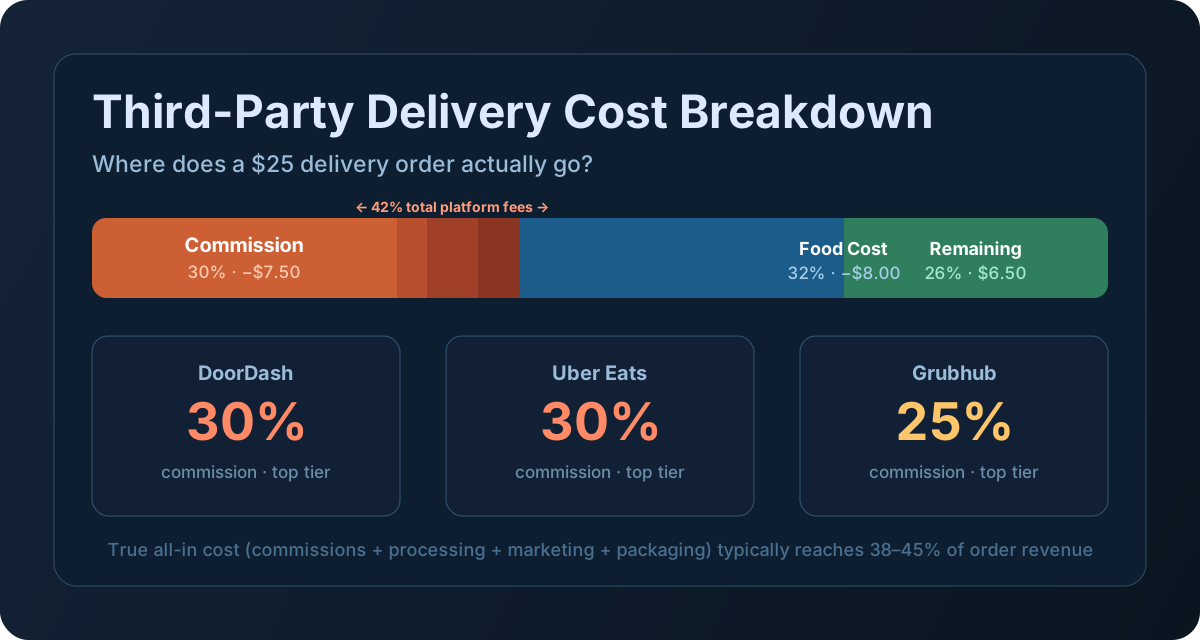
The real cost of third-party delivery — commission, processing, marketing, packaging, and tablet fees typically stack to 38–45% of order revenue, not the stated 15–30%.
2
Net Order Revenue
Order Subtotal − Total Platform Fees
What actually lands in your account. On a $25 order at 42% all-in platform cost, you receive $14.50 — not $25.
3
Net Margin per Order
Net Order Revenue − Food Cost
On that $25 order: $14.50 net revenue minus $8.00 food cost (32%) leaves $6.50 — just 26% — to cover kitchen labor, overhead, and profit. The math only works with delivery-specific pricing.
That $6.50 on a $25 order must cover the kitchen labor to prepare the order, the allocated overhead for the order's share of rent and utilities, and any profit. For a full-service operation with 30%+ labor costs, this math rarely produces meaningful margin — and at higher food cost or lower average order values, it can go negative. The delivery channel is not inherently unprofitable, but it is only profitable when menu pricing, platform tier, and order economics are engineered specifically for delivery, not borrowed from the dine-in menu.
Tutorial: How to Analyze Delivery Profitability in Restaurant Core Systems
Menu and Costing → Menu Costing → Delivery Channel View → Platform Cost Layer
RCS helps operators build delivery-specific cost analysis by layering platform costs on top of plate cost data. Here is how to run the workflow:
In Menu and Costing → Menu Costing, open each item that appears on your delivery menu. Confirm the current plate cost using live ingredient pricing from recent invoice ingestion. Delivery items should be costed at current purchase prices, not historical averages — platform economics are tight enough that stale cost data produces misleading margin estimates.
For each delivery item, calculate the true platform cost percentage using the formula above: commission rate + payment processing + estimated marketing and packaging. For most full-commission platform tiers, budget 40–43% as your working estimate of true all-in cost.
Calculate the net revenue remaining after platform cost: Menu Price × (1 − True Platform Cost %). Then subtract plate cost. The result is your gross margin per order before labor and overhead. If this number is below 15–20% of the original menu price for typical items, your delivery menu is likely not profitable at current pricing.
Identify every item where current delivery pricing produces insufficient margin. For each item, model two scenarios: (a) what delivery price would you need to achieve a 20% gross margin after platform cost and food cost; (b) is that price within a range your market will tolerate for a delivery order. If not, consider removing the item from the delivery menu rather than selling it at a loss.
Compare net revenue performance across your delivery platforms. If you are on multiple platforms at different commission tiers, RCS can help you model which platform generates the best net economics given your actual order mix and average check size on each. Volume on a cheaper tier does not automatically beat lower volume on a pricier tier if average order values differ significantly.
Build a delivery-specific menu within RCS that reflects delivery pricing (typically 10–20% higher than dine-in for high-commission tiers) and only includes items with defensible delivery margins. Track the food cost percentage on delivery orders separately from dine-in food cost — blending the two hides the delivery channel's true margin impact.
Review delivery channel economics quarterly. Platform commission structures, processing fees, and marketing requirements change. An arrangement that was marginally profitable six months ago may no longer clear the threshold after a tier restructure or fee increase. Building quarterly delivery P&L reviews into your operating cadence catches these changes before they compound.
The direct ordering alternative: for operators ready to build a direct ordering channel, RCS consulting includes a full delivery channel audit — quantifying what you are currently paying across all platforms, identifying which order types and items have viable economics, and building the business case for direct ordering investment. Typical direct ordering costs run 3–4% of order value (payment processing only), compared to 40%+ through major platforms. The breakeven on direct ordering infrastructure is achievable at modest monthly volumes for most concepts. Contact info@restaurantcoresys.com to schedule a delivery economics review.
Know exactly what each delivery platform is costing you.
RCS breaks down per-order delivery economics so you can price your delivery menu correctly, choose the right platforms, and build toward direct ordering on your own timeline.