Menu Psychology: Design Tricks That Increase Average Check by 15%
Your menu is doing sales work before your server says a word. The placement of items, the structure of your price tiers, the presence or absence of dollar signs, and the proximity of add-ons to anchor items all influence what guests order — and how much they spend. Menu psychology is how profitable operators engineer that influence deliberately.
12 min readWritten by: RCS Product Team
What You Will Learn
From Menu Layout to Measurable Check Increase
This guide explains what menu psychology is, the five principles that move the average check most reliably, how to measure the result against your plate cost data, and how RCS menu engineering ties behavioral design to margin math for a measurable P&L outcome.
Menu psychology is the application of behavioral economics principles to menu design — arranging items, prices, descriptions, and visual hierarchy in ways that influence guest ordering decisions toward outcomes the operator prefers. It is not manipulation; guests order what they want. Menu psychology ensures that when two items are both appealing, the item with a better contribution margin is the one a guest is more likely to choose.
The discipline draws from decades of consumer psychology research. Guests scanning a menu spend an average of 109 seconds reviewing it before ordering. In that time, their attention follows predictable patterns influenced by placement, contrast, white space, anchor prices, and social proof signals like "most popular" or "chef's favorite" callouts. A menu designed with these patterns in mind completes, as researchers describe it, "half the upselling task" before a server is involved.
The financial stakes are significant and concrete. Research shows that restaurants focusing on upselling and check-building techniques boost revenue 10–15% per table. Three-tier pricing structures increase average check by 15–20%. A $0.75 pricing error — whether from poor placement, wrong tier structure, or a mispriced anchor — costs $100,000 per year at 350 covers per day. Menu psychology is not a nice-to-have for brand-conscious operators. It is a revenue tool with a calculable return.
Critically, menu psychology only works when it is anchored to accurate plate cost data. Steering guests toward your "best margin" item requires knowing which item actually has the best margin — not guessing based on price alone. A high-price item with a high plate cost may generate less contribution margin per cover than a mid-price item with a very low plate cost. Menu engineering — the combination of menu psychology and cost data — is the framework that produces reliable results rather than cosmetic changes.
What Menu Psychology Is Used for in Restaurants
Operators apply menu psychology across every format and price tier, though the specific techniques vary by concept type and menu format:
Increasing average check without adding covers. More covers require more staff, more space, more time. Increasing the average check on existing covers is the highest-leverage revenue move available to a restaurant: zero incremental fixed cost, full margin on the additional spend. Menu design is the primary tool for doing this systematically.
Directing traffic toward high-margin items. Menu engineering classifies every item on a four-quadrant grid based on two variables: contribution margin (dollars per cover, not food cost percentage) and sales volume. "Stars" are high margin and high volume — the goal of menu design is to make these items easier to find and more compelling to choose. "Plowhorses" are high volume but low margin — the goal is to reprice, re-engineer, or reposition them. Menu layout executes that strategy visually.
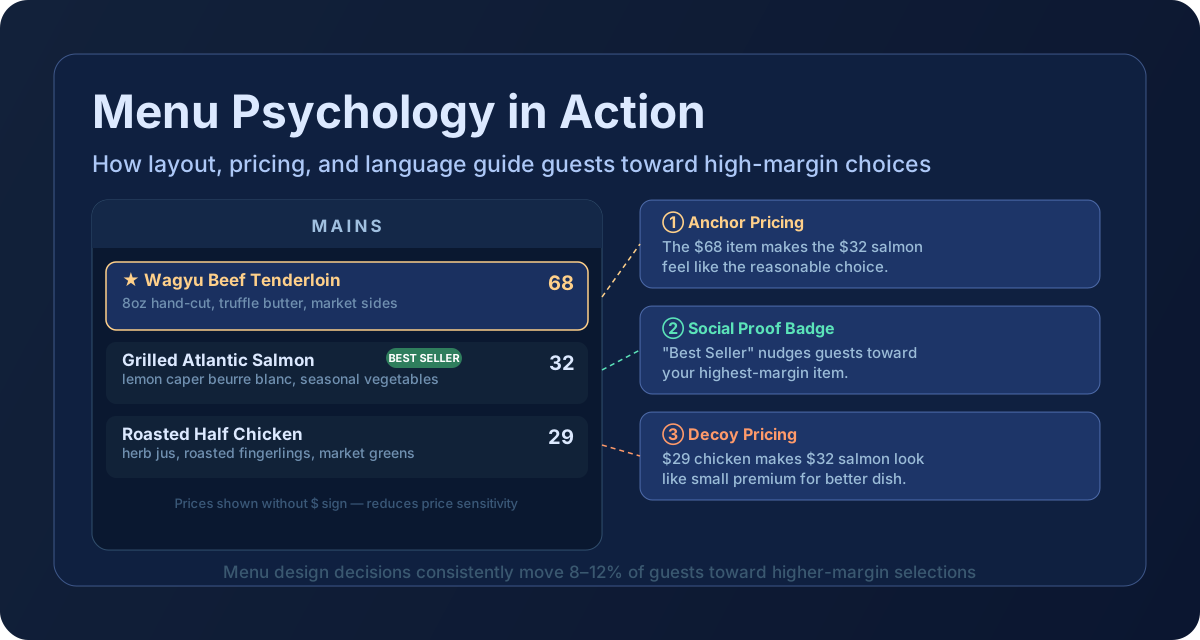
Reducing price sensitivity. Research consistently shows that guests are less price-sensitive when menus remove dollar signs, use clean numeric pricing rather than decimal formats, and anchor prices with one or two premium items that make moderate items feel like reasonable choices. These are formatting decisions that cost nothing to implement and measurably change ordering behavior.
Driving add-on and upsell behavior. Strategic placement of additions, sides, and premium modifiers adjacent to their natural anchor items increases uptake rates without requiring server intervention. A well-placed truffle upgrade next to the pasta or a wine pairing suggestion next to the entrée section generates incremental revenue on orders that would otherwise close at the base price.
Supporting new item introduction. When launching a new menu item, placement and pricing context determine whether it gets sampled or ignored. A new dish positioned in a visual sweet spot, priced as the accessible mid-tier option in its category, and flanked by a premium anchor item will outsell the same dish buried at the bottom of a category list at an identical price point.
Online and digital menu optimization. The same principles apply to digital menus, delivery platform menus, and QR-code menus — and the stakes are higher because guests on delivery platforms are making purchase decisions with no server to provide context. Item sequencing, photo selection, and pricing structure on delivery menus directly affect both order volume and average order value.
How Menu Psychology Principles Work
Five techniques account for the majority of measurable check improvement in menu engineering engagements. Each can be applied independently, but they produce compounding results when implemented together.
1
Contribution Margin
Menu Price − Plate Cost
The profit dollars this dish generates per cover. Menu psychology optimizes this — not food cost %. A dish with a higher food cost % can still earn more margin per plate.
Small layout changes compound fast — removing dollar signs, adding "Popular" badges, and structuring price tiers can lift average check by 25–40% when applied together.
1. Decoy pricing (anchor effect). Place one high-price, high-margin item near the items you most want to sell. A $72 wagyu steak on the same page as your $28 branzino does not primarily exist to sell wagyu — it exists to make $28 feel like a bargain and reduce the mental friction of ordering it. The anchor item reframes the guest's price reference point for everything near it. Choose an anchor that genuinely represents quality at its price so guests do not feel manipulated, and ensure the items you want to sell are the most attractive options in the $22–$35 range adjacent to it.
2. Three-tier pricing ("good, better, best"). Within any category — proteins, pasta, salads — offer three options at meaningfully different price points. Research consistently shows guests default to the middle option at roughly 60–70% of the time, regardless of the absolute price levels. The goal is to engineer the middle option to be your highest-contribution-margin item in that category, not just the middle price. If your best-margin chicken dish is currently priced as the cheapest option in the protein section, repositioning it as the accessible middle tier — with a premium item above it and a value item below it — typically increases both its sales volume and its perceived value.
3. Visual sweet spots and strategic placement. On a two-panel menu, the eye moves to the upper right panel first, then the upper left. On a single-column digital menu or tablet, the top and bottom positions in each category receive disproportionate attention. Items in these positions sell significantly more than items buried in the middle of long category lists — independent of price or description quality. Map your highest-contribution-margin items to these positions. Audit your current menu layout against your menu engineering data: if your best-margin items are in low-attention positions, you are leaving money on the table in every service.
4. Pairing prompts and contextual add-ons. The moment of decision for an add-on is when a guest is actively engaged with the item it complements. "Add truffle oil +$4" printed directly under a pasta description, or "Wine pairing available — ask your server" in the entrée section, captures upsell revenue that would otherwise require server intervention to generate. Position pairing suggestions immediately adjacent to anchor items, not in a separate section that requires page-turning. On digital menus and ordering platforms, use mandatory modifier prompts ("Would you like to add...?") to capture add-on revenue that guests simply do not think to request unprompted.
5. Price formatting and dollar sign removal. Studies in consumer psychology consistently show that including currency symbols ($) activates a "pain of paying" response that makes guests more price-sensitive. Presenting prices as clean numerals (28 rather than $28.00) reduces this sensitivity and increases ordering rates at higher price points. Avoid right-aligned price columns with a leader line from item name to price — this format, ubiquitous in older menu design, trains guests to scan the price column first and order from the bottom up. Embed prices within the item description instead, forcing the guest to read the item before processing the price.
Tutorial: How to Use Menu Engineering in Restaurant Core Systems
Menu and Costing → Menu Costing → Item Analysis → Contribution Margin Sort → Engineering Review
Menu psychology produces measurable results when it is grounded in accurate plate cost and sales mix data. RCS provides the cost side of the equation; your POS provides the sales mix. Together, they give you the full menu engineering picture. Here is how to run the workflow:
In Menu and Costing → Menu Costing, ensure all menu items have current plate costs calculated from live ingredient pricing. Items with outdated costs — especially proteins and dairy, which have seen the most volatility — will produce misleading contribution margin calculations. Run invoice ingestion and apply invoices before beginning a menu engineering review.
For each item, note the plate cost, menu price, and calculated contribution margin (menu price minus plate cost in dollars). Sort items within each menu category by contribution margin from highest to lowest. This ranking — not food cost percentage — is the primary menu engineering metric.
Cross-reference contribution margin ranking with sales volume data from your POS for the same review period (typically 4–8 weeks of sales data for statistical reliability). Plot each item on the four-quadrant grid: Stars (high CM, high volume), Plowhorses (low CM, high volume), Puzzles (high CM, low volume), Dogs (low CM, low volume).
Identify your Stars — the items with both strong contribution margin and strong sales volume. These are the items that should occupy visual sweet spots on your menu, receive social proof callouts, and anchor your three-tier pricing structures. If a Star is currently buried in a mid-list position without any visual emphasis, that is the first corrective action.
Identify your Plowhorses — high-volume items with insufficient contribution margin. For each, model two interventions: (a) price increase needed to move contribution margin to target, expressed as a dollar amount and percentage change; (b) plate cost reduction through recipe adjustment that achieves the same outcome at the same price. Both options are visible within RCS — the pricing scenario on the Menu Costing screen and the recipe adjustment on the Plating Recipe tab.
Identify Puzzles — high-margin items that are not selling at volume. The cause is usually placement, description, or pricing context. Reposition these items to higher-attention menu locations, add descriptive copy that builds perceived value, and consider whether they are anchored effectively by a premium decoy above them in their category.
After implementing layout and pricing changes, set a review date 6–8 weeks forward. Pull the same four-quadrant analysis on updated POS sales data. Menu engineering changes take time to normalize in sales mix — single-week data after a menu change is not statistically meaningful. The 6–8 week comparison is the measurement point for attributing check-average lift to specific design interventions.
RCS menu engineering consulting: the RCS team conducts full menu engineering engagements that combine plate cost data from RCS software with POS sales mix analysis, four-quadrant classification, and redesign recommendations delivered with measurable ROI targets. For operators who have plate cost data but have never applied menu engineering principles to their layout or pricing structure, this engagement typically produces a 10–20% average check improvement within 60–90 days of implementation. Contact info@restaurantcoresys.com to learn more.